
When to Duplicate Facebook Ads: Testing & Scaling
Duplicating ads is one of the most powerful (and misunderstood) tactics in Meta advertising. Here's when to do it, when to avoid it, and how to do it right.

Key Takeaways
- 1Duplication creates copies of ads, ad sets, or campaigns while keeping originals untouched
- 2Three primary use cases: creative testing, scaling spend, and restarting delivery
- 3Don't duplicate to "reset" poorly performing ads — that rarely works
- 4Budget allocation between original and duplicate matters significantly
Key Takeaways
- Duplication creates copies of ads, ad sets, or campaigns while keeping originals untouched
- Three primary use cases: creative testing, scaling spend, and restarting delivery
- Don't duplicate to "reset" poorly performing ads — that rarely works
- Budget allocation between original and duplicate matters significantly
- Automation can handle duplication rules based on performance triggers
What Duplication Actually Does

This sounds simple, but the implications are significant. That fresh start means:
- The duplicate enters Meta's learning phase
- It has no performance history
- It competes for the same audience as the original
- Budget is split (unless you adjust)
The Three Valid Reasons to Duplicate
Reason #1: Creative Testing
You have a winning ad set and want to test new creative variations. Duplicating lets you test under identical conditions — same audience, same budget allocation, same settings.
The only difference is the creative itself. Everything else stays constant. That's how you isolate what's actually driving performance changes.How to do it:
Reason #2: Scaling Spend
You have a winning ad set hitting its limits. Increasing budget too aggressively (>20% at once) can destabilize performance. Duplication offers an alternative.
The approach:Reason #3: Restarting Delivery
Sometimes an ad set loses momentum. Engagement drops, CPAs rise, delivery slows. Duplication can give it a fresh start in Meta's learning phase.
When this works:- Ad set was performing well, then declined
- You've diagnosed the issue (fatigue, competition, seasonality)
- You've refreshed the creative or adjusted targeting
- Ad set never performed well
- You're duplicating without changing anything
- The issue is fundamental (bad offer, wrong audience)
When NOT to Duplicate
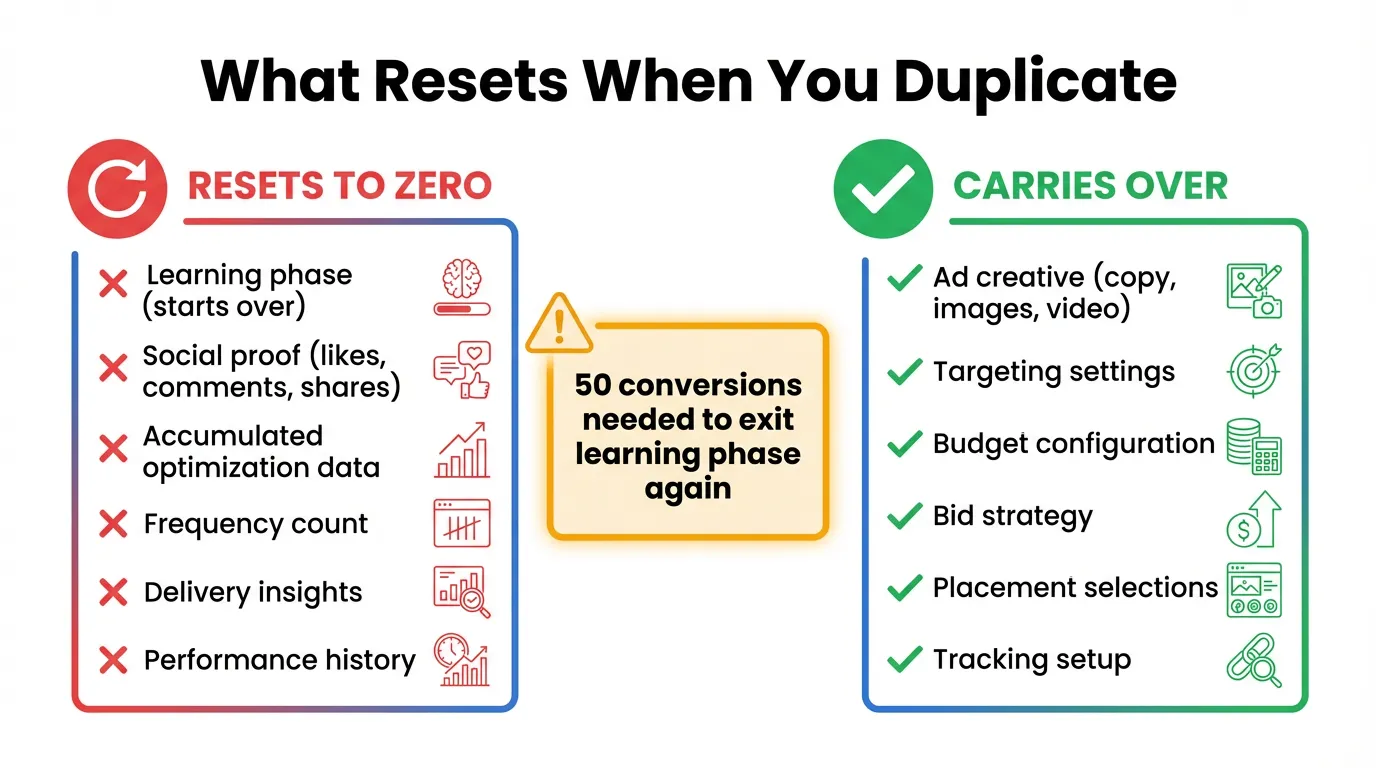
Don't: Duplicate to "Reset" Bad Ads
If an ad isn't working, duplicating it won't help. The algorithm already learned it underperforms. Starting over just wastes more budget re-learning the same lesson.
Don't: Duplicate Constantly
Every duplication creates audience overlap. If you have 5 duplicates of the same ad set, they're all competing for the same users. Frequency goes up, costs go up, efficiency goes down.
Don't: Duplicate Without a Hypothesis
Ask yourself: "What do I expect to be different?" If you can't articulate a hypothesis, you're just hoping for different results from the same inputs.
How to Duplicate Properly

Ad Level Duplication
Use for: Testing creative variations within an ad set
Steps:Ad Set Level Duplication
Use for: Testing audiences, placements, or scaling
Steps:Campaign Level Duplication
Use for: Testing campaign objectives or completely separate tests
Steps:Managing Budget Allocation
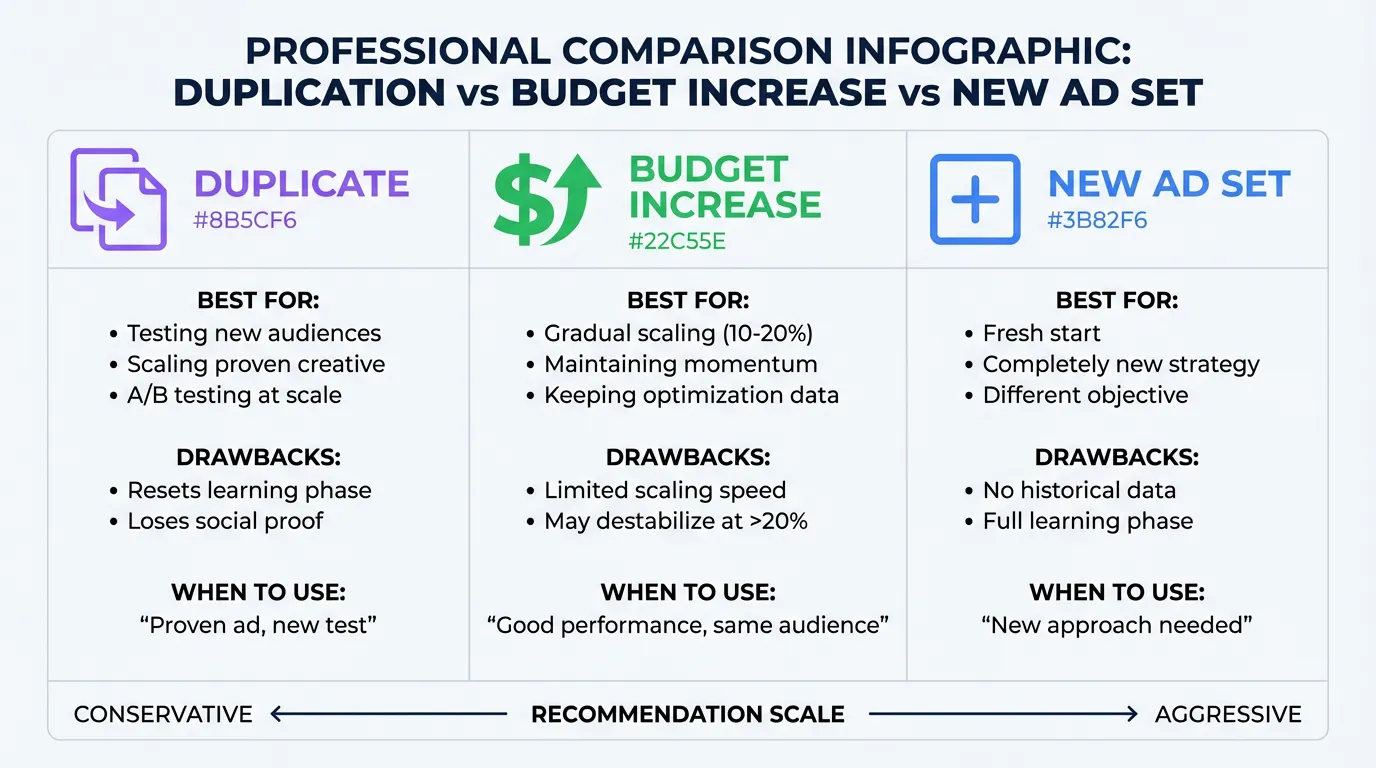
When you duplicate, budget management becomes critical.
Option 1: Manual Split
- Set specific daily budgets for original and duplicate
- Pro: Full control
- Con: May underdeliver if one audience segment runs out
Option 2: Campaign Budget Optimization (CBO)
- Let Meta distribute budget between ad sets
- Pro: Algorithm finds winning combinations
- Con: Less control over testing purity
Automation for Duplication
Manual duplication works at small scale. But if you're testing dozens of creatives or managing multiple accounts, automation saves hours.
Automated Duplication Rules
Set triggers based on performance:
Example: Scale Winners- IF ad set ROAS > 3x for 3 consecutive days
- AND daily spend > $50
- THEN duplicate ad set with 1.5x budget
- IF frequency > 4
- AND CTR dropped >30% from week 1
- THEN pause ad set, duplicate with new creative
Tools for Automation
Native Ads Manager rules are limited. Third-party tools like AdBid offer:
- More sophisticated trigger conditions
- Cross-account duplication
- Performance-based creative rotation
- Automatic budget reallocation
Measuring Duplicate Performance
The Right Comparisons
Compare duplicate vs. original on:
- Cost per result
- ROAS
- Frequency
- Audience saturation
The Wrong Comparisons
Don't compare:
- Raw spend (depends on budget allocation)
- Raw conversions (depends on budget allocation)
- Performance in first 3 days (learning phase noise)
The Bottom Line
Duplication is a tactic, not a strategy. It works when you have a specific reason — testing creative, scaling carefully, or restarting with changes. It fails when used as a Hail Mary for underperforming campaigns.
If you can't answer these, don't duplicate.
Want automated rules for smart duplication? AdBid can duplicate winning ad sets, pause fatigued ads, and reallocate budget based on performance — all without manual intervention. Try AdBid free for 14 days.
Ready to optimize your ad campaigns?
Try AdBid free for 14 days. No credit card required. See how AI-powered optimization can transform your advertising.
Related Articles
How to Boost a Post on Facebook: Complete Guide for 2025
How We Helped E-commerce Scale to $600K Daily Ad Spend
Understanding Meta Advantage+ Sales Campaigns: 2025 Guide
Essential Guide to Building a Creative Testing Framework

Meta Advertising Policies in 2025: What You Need to Know
7 Best Facebook Ads Reporting Tools for Marketers in 2025
More in Guides
View all →
The Complete Guide to AI-Powered Ad Optimization in 2025
How to Scale Mobile App Advertising in 2025
The Ultimate Guide to Google Ads Automation Tools
Getting Started with TikTok Ads: A Complete Beginner's Guide
Meta Opportunity Score: What It Means & How to Use It
